Associate Editor's Letter
Abstract
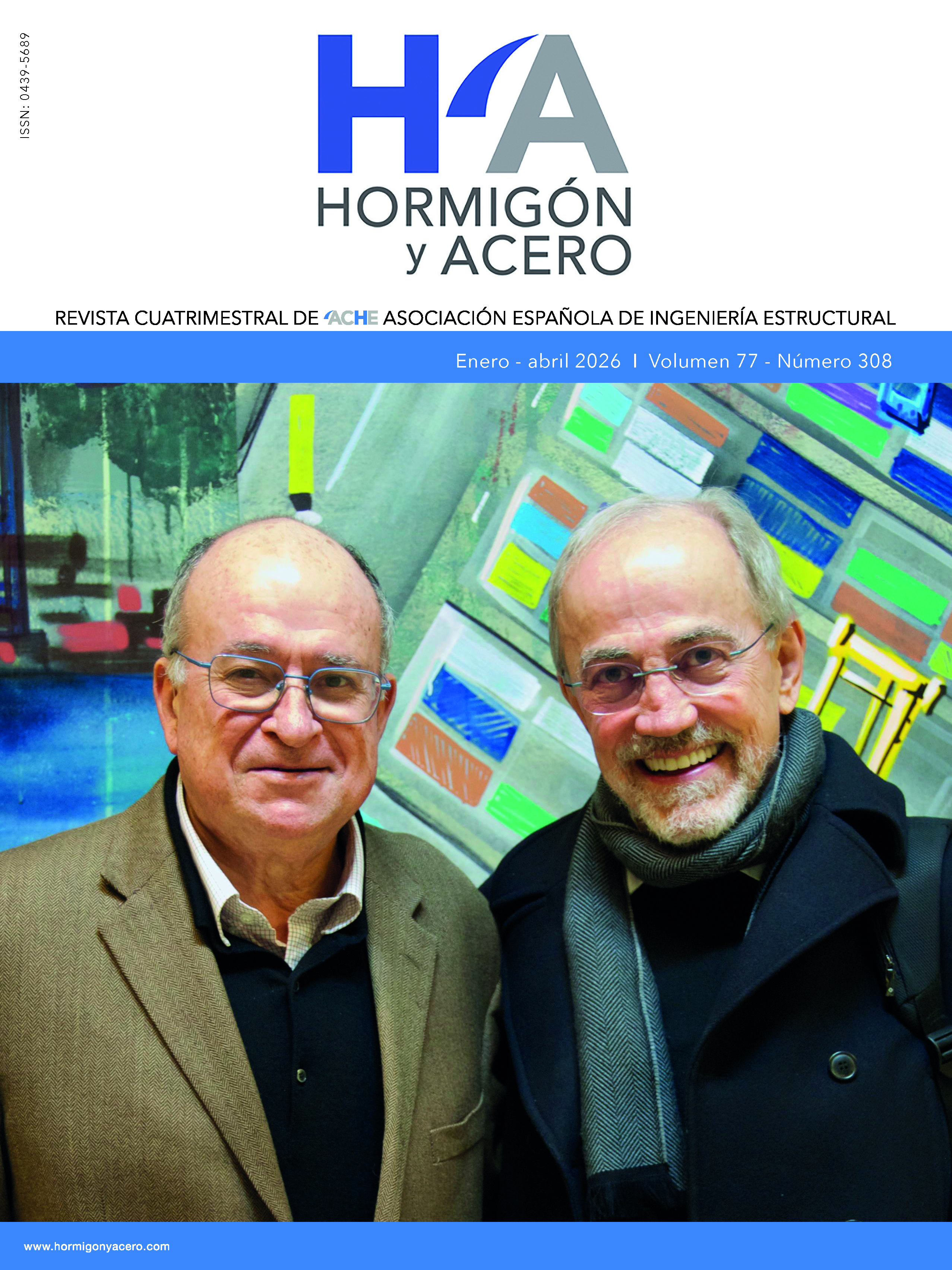
With this special issue, Hormigón y Acero acknowledges the contribution made by two recently retired professors to the modernization and updating of Spanish structural regulations and codes: Antonio Marí Bernat and Hugo Corres Peiretti. Over more than four decades, their path ran parallel, fostering the development of knowledge in the field of structural concrete in Spain.
Both were educated as civil engineers in the second half of the 1970s and obtained their PhDs in 1981 and 1980, respectively. From an early stage, they embarked on an intense academic and research career focused on the analysis of the mechanical behaviour of reinforced and prestressed concrete, contributing decisively to their integration under the unifying concept of structural concrete, thus overcoming the former dichotomy between the two technologies.
They attained full professorships in the late 1980s and early 1990s, becoming leading figures of a generation that transformed the understanding of structural concrete in Spain. They shared the conviction that this discipline should be grounded in sound mechanical models, rigorously justified safety criteria, and regulations consistent with the most advanced state of knowledge.
From the Universitat Politècnica de Catalunya and the Universidad Politécnica de Madrid, respectively, they played a decisive role in the creation of two schools characterized by scientific rigor and coherence between theory and practice. Their participation in the Permanent Commission on Concrete and in national (ATEP, GEHO, ACHE) and international associations (CEB, FIP, fib, and Eurocode committees) was instrumental in shaping this shared vision. This convergence culminated in the Spanish Code for Design of Concrete Structures EHE (1998), and later in EHE-08 (2008 edition), for which they served as principal rapporteurs and conceptual driving forces. These documents were not a mere code update, but the synthesis of decades of research, teaching, and professional practice. After nearly a quarter of a century of application, they also supported the transition to the Structural Eurocodes, now increasingly implemented in Spanish engineering practice, thus promoting the integration of European standards into the national regulatory framework.
This special issue therefore pays tribute to two professors who educated several generations of engineers and who successfully combined their academic work with an intellectual and professional endeavour. The careful interplay between these two dimensions allowed them to forge rigorous and practical knowledge that shaped the evolution of structural engineering in Spain.
Through the contributions of the various authors, this issue brings together articles that spans three essential dimensions of the discipline of structural engineering, where the reader will be able to find contributions on scientific research, innovations in design and construction techniques, as well as analysis of humanistic and historical perspective of structural concrete and engineering. Moreover, the fact that both honourees are internationally recognized figures is reflected in the diversity of specialists—both international and national—who have contributed to this issue, providing a rich plurality of approaches and a strong international outlook.
For us, it is a great honour to present this commemorative issue to the reader, which offers high-quality contributions in three fundamental pillars of civil engineering.