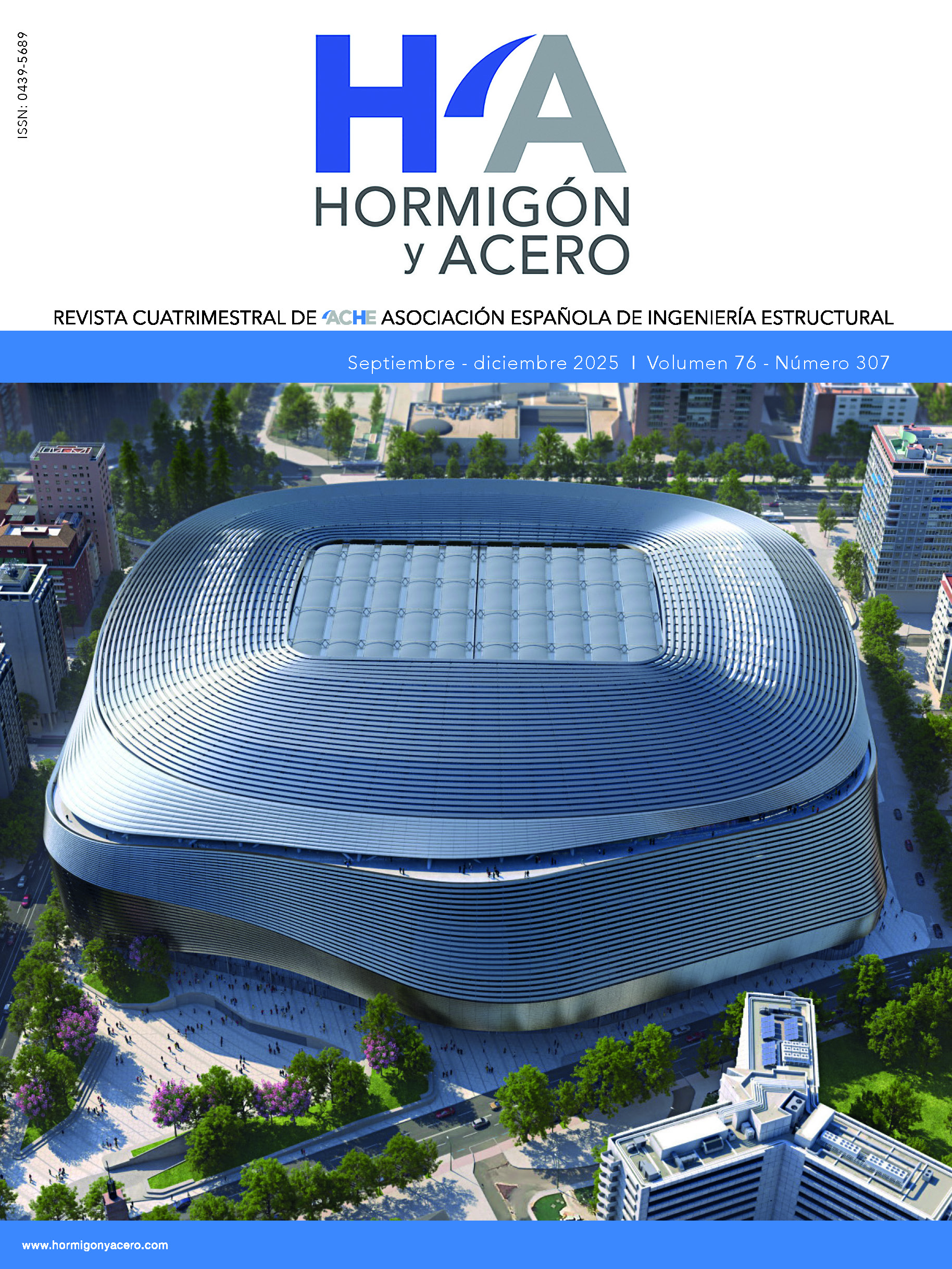
Renovation of the Santiago Bernabéu Stadium. Engineering for the design an structural analysis of the slatted façade
DOI:
https://doi.org/10.33586/hya.2025.3984Keywords:
Fabricación digital, Parametrización, Doble curvatura, FachadaAbstract
The increasing ability to define complex geometries in digital environments connected with manufacturing processes has enabled the execution of envelopes without geometric or serialization constraints. Two fundamental aspects that have shaped the constructive viability of complex geometries have been: representation tools and the interconnection between professionals. Since the 1990s, the use of Computer-Aided Design (CAD) programs quickly highlighted the inherent need of the architectural construction process to create specific mathematical algorithms. Architects such as Frank Gehry, Future Systems, Nicolas Grimshaw, and Zaha Hadid have been pioneers in employing digital tools to determine complex geometries and their exportation to the construction process, with examples such as “The Fish,” the Guggenheim Museum in Bilbao, the Walt Disney Concert Hall, the Innsbruck Station, or “The Bubble.”
The significant evolution in the field of software applied to the design of complex surfaces, linked to complex production and manufacturing processes, has been indispensable for unique façade projects like that of the Santiago Bernabéu Stadium to be possible. This article includes a detailed exposition of the example set by the design and construction of the new façade of the Santiago Bernabéu Stadium as a new paradigm of the digital design and manufacturing process in large-scale construction.